
FREQUENTLY ASKED QUESTIONS
With a Spray bottle:
- Dilution 4% = 10ml (1 cap) of product per 250ml of water.
- Dilute the product with water in the spray bottle, first fill with water, then add product.
- Very sparingly spray the surface to be cleaned.
- Wipe dry with an absorbent cloth (microfibre).
- Use diluted product within 6 months of mixing.
With a bucket and mop/sponge:
- Dilution from 0.3% = 30ml of product per 10 litres of water.
- Dilute the product with water in the bucket, first fill with water, then add product.
- Apply the product with a mop or sponge and remove the dirt.
- Wipe dry with an absorbent cloth.
Related product
Synbio Sanitary / Synbio Interior
With a Spray bottle:
- Dilution 4% = 10ml (1 cap) of product per 250ml of water.
- Dilute the product with water in the spray bottle, first fill with water, then add product.
- Very sparingly spray the surface to be cleaned.
- Wipe dry with an absorbent cloth (microfibre).
- Use diluted product within 3 days of mixing!
With a bucket and cloth:
- Dilution from 0.5% = 5ml of product per 1 litres of water.
- Clean as usual
- Use diluted product within 3 days of mixing!
Synbio Floor / Floor Scrub
With a bucket and mop:
- Dilution from 0.5% = 5ml of product per 1 litres of water.
- Clean as usual
- Use diluted product within 3 days of mixing!
With a scrubbing machine:
- Dilution from 0.5% = 50ml of product per 10 litres of water.
- Mix well.
- Operate the floor scrubber dry in the usual way.
Related product
A simple explanation is that we put billions of good bacteria (probiotics) on the surfaces we clean, they eat all the available food and cause the germs (bad bacteria) to starve and die.
We also infuse prebiotics into most of our products. The prebiotics serve as food for the probiotics as well as ensuring an immediate activation for the probiotics, as soon as they touch the surfaces.
The probiotics also produce up to 26 different types of enzymes, which they use to break down any dirt they find on the surface and use it (and prebiotic sugars) as food, thus allowing them to continue to clean and protect for at least 5 days!
For more detailed information, please refer to our Science page.
Related product
With a Spray bottle:
- Dilution 4% = 10ml (2 x inside of cap) of product per 250ml of water.
- Dilute the product with water in the spray bottle, first fill with water, then add product.
- Very sparingly spray the surface to be cleaned.
- Wipe dry with an absorbent cloth (microfibre).
- Use diluted product within 6 months of mixing.
With a bucket and mop/sponge:
- Dilution from 0.3% = 30ml of product per 10 litres of water.
- Dilute the product with water in the bucket, first fill with water, then add product.
- Apply the product with a mop or sponge and remove the dirt.
- Wipe dry with an absorbent cloth.
Related product
The patented combination of probiotics and prebiotics in one product is called synbiotics. The synbiotic products form a healthy microflora during and after cleaning for optimum sustainable hygiene and rigorous infection control, over time.
Probiotics are live microorganisms, otherwise referred to as “Good Bacteria”.
“Probiotics are defined as live microorganisms that confer a health benefit on the host. The most common types of microbes used as probiotics are lactobacilli and bifidobacteria, which are generally consumed as part of fermented foods, such as yoghurts or dietary supplements. Criteria for probiotic bacteria include that the bacterial strain:
- Must be able to survive in the gastrointestinal tract and to proliferate in the gut;
- Should exert benefits to the host through growth and/or activity in the human body;
- Should be non-pathogenic and non-toxic;
- Provide protection against pathogenic microorganisms by means of multiple mechanisms; and
- Should be lacking transferable antibiotic resistance".
The probiotic and synbiotic solutions from Synbio Shield contain multiple types of probiotic bacteria.
We use multiple non-GMO bacteria that are beneficial for cleaning and improving the microbiomes our products are aimed at.
Prebiotics are sugars that can only be digested by good microorganisms. In the case of the synbiotic products, prebiotic sugars are also present, which stimulate the already present good microorganisms through a delayed action. In this way, Synbio Shield’s synbiotic products feed the already present good microorganisms which promotes the diversity of the microflora in a positive direction
While the Synbio Shield range of products is not intended to kill or prevent the emergence of mould, it often helps in an indirect manner:
- The probiotics in the cleaning products require moisture to multiply and continue to protect the surface, thus using moisture that would otherwise help mould spread.
- Some of the probiotics use mould biofilm and allergens as a food source or pollution, break them down by producing enzymes that help with the physical removal of the mould.
- The probiotics also starve the germs that produce the biofilm ("black mould"). With regular cleaning - Synbio Shield's cleaners can assist in managing and reducing the emergence of mould.
Related product
It is now understood that real hygiene and infection control is no longer the radical control of all microorganisms, but instead the maintenance of a balanced and healthy microbiome.
Our synbiotic technology ensures optimum hygiene by:
- Keeping a surface clean via a cleaning effect, and
- Supporting good microorganisms.
1. Keeping a surface clean through a cleaning effect:
Cleaning has been at the basis of hygiene for a century. “Cleaning means breaking down dirt, which separates the dirt from the substrate and brings it into a dissolved or colloidal state and makes it easier to remove mechanically and / or physically."
The purer a surface can be kept, the smaller the chance that microorganisms can develop, since they can only feed on pollution. Each type of cleaning and each type of cleaning product will therefore give rise to a lower risk of microbial contamination by reducing the contamination.
Traditional cleaners work via surface-active (chemical) substances that bind to dirt to release it. Enzymatic cleaners add enzymes (biological substances) that act on certain specific contaminants for longer.
Synbio Shield developed the latest technology in the field of cleaning: probiotic cleaning. The effect of the probiotic product is based on the combination of surfactants and probiotics.
The major advantage that Synbio Shield’s probiotic products have over traditional chemical or enzymatic cleaners is that the 100% natural probiotic can analyse the surface to see which type of dirt is present. They will then produce highly targeted enzymes on site for multiple days that will break down the contaminated soil and separate it from the substrate and bring it into a dissolved or colloidal state making it easier to remove mechanically and / or physically. This therefore ensures a much wider and longer operation. Probiotic cleaners ensure maximum cleaning!
2. Supporting good microorganisms:
Killing all unwanted microorganisms is no longer the solution. This causes resistance and instability in the microflora. Synbio Shield’s probiotic and synbiotic technology ensures a stable, healthy microbiome through the stimulation of good microorganisms. The high number of probiotics in the products immediately increases the number of good bacteria on the surface (after all, the probiotics are good micro-organisms themselves). In the case of the synbiotic products, prebiotic sugars are also present, which stimulate the already present good microorganisms through a delayed action.
There is an important difference between cleaning and disinfection, both of surfaces and of our body.
Cleaning: Removing dirt from a surface (such as a material or our skin). This is done with soaps (or detergents), or by manually removing the dirt using cloths, etc.
Disinfection (or Sanitizing, Decontamination): Making a surface free of all microorganisms by killing them. This is done with biocides (or disinfectants).
Both soaps and biocides are completely chemical in composition, the biocides containing an active substance that is killing micro-organisms. Nowadays, soaps and biocides are sometimes combined, whereby one product should do both cleaning and killing (eg Anti-Bacterial soaps). The ultimate goal is therefore to ensure that microorganisms and their food source (= dirt) are no longer present in our environment through cleaning and disinfection.
The use of the detergents and disinfectants initially worked well, and it was fairly easy to make a surface free of dirt and microorganisms. However, due to their long time on earth, microorganisms have learned to adapt rapidly to changing circumstances. Very quickly (a few decades) after the introduction of disinfectants, the microorganisms found ways to circumvent this threat, which we now call resistance.
This means that the microorganisms are increasingly able to survive an attack of disinfectants. Disinfectants and sanitisers are therefore becoming less and less effective.
There is also an increasing problem with regard to cleaning agents. One of the mechanisms that the microorganisms use to defend themselves against these chemical attacks is the formation of increasingly tenacious biofilms. As a result, the cleaning agents (soaps, detergents) can no longer efficiently remove dirt from surfaces because it is increasingly stuck in biofilms that are almost impenetrable to soaps and chemicals.
We can see this clearly in hospitals and other healthcare environments, where constant disinfecting of surfaces has caused the emergence of ever-evolving strong and dangerous bacteria (such as MRSA) which cause and increasing number of sepsis and resistance-related deaths every year.
In addition to the Resistance issue, there is a greater danger behind chemical cleaning and disinfection. The influence on microbial dynamics is such that the microbial community or microflora is increasingly directed towards a harmful microflora.
What happens with chemical cleaning and disinfection:
If we take a surface where there is food, moisture and space to keep a microbial community of up to 100 microorganisms alive; immediately after disinfection, the number of microorganisms will have reduced sharply.
However, due to the resistance, a number of microorganisms will survive this disinfection. A disinfectant has no after-effect, so these survivors will start to regrow after a few minutes. After all, they suddenly have a lot of space (the vacant places of the killed microorganisms), food (the killed microorganisms themselves serve as a source of food) and moisture (brought along with the disinfectants).
Since resistant harmful germs survive a disinfection attack best, and therefore grow faster, each disinfection will result in a microbial community that contains more and more resistant harmful germs.
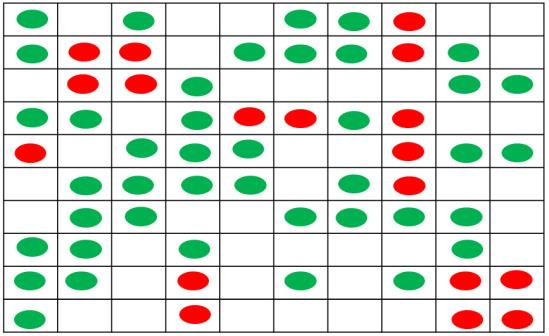
Natural surface microflora
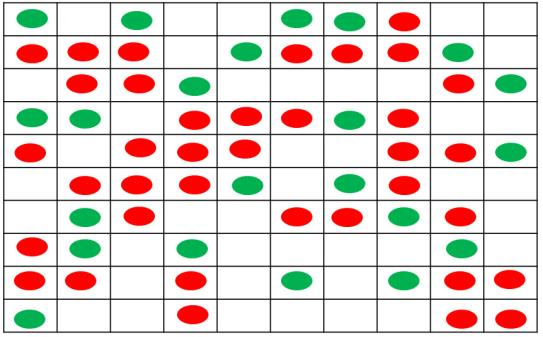
Sufrace microflora after disinfection / decontamination
Both surfaces still have the same number of microorganisms, but the proportion of harmful germs is much higher due to resistance problems when disinfectants are used.
The more humans use disinfectants, the more resistant and harmful germs are found.
This is the decontamination paradox.
Because probiotic and synbiotic cleaning is a new technology, HEIQ-Chrisal (which manufactures the Synbio Shield products) has devoted a great deal of attention from the start of the development to demonstrating the safety of the products and especially the probiotic strains used
- Synbio Shield probiotics and synbiotics meet the following criteria:
- All probiotics used belong to ATCC safety class 1 (= highest safety)
- The pro / prebiotics are 100% natural, not genetically modified (non-GMO)
- The pro / prebiotics are listed on the list of safe ingredients of the European Food Safety Agency (EFSA) for processing in food
- Passed the following official OECD safety tests:
- Food safe according to the American FDA (GRAS status)
- OECD 403 Inhalation toxicity
- OECD 404 Acute skin irritation / corrosion
- OECD 405 Acute eye irritation / corrosion
- OECD 406 Skin sensation
- The products meet the EU Ecolabel criteria
- The prebiotics and probiotics meet the criteria for use in cosmetics
- Over 10 years of safe use in hospitals and clinical studies
Product quality
To guarantee the proper functioning and safety of every product, a sound quality system is of great importance. HEIQ-Chrisal has the ISO9001 quality certificate since 1999. This guarantees the proper functioning of the entire company. In addition, HEIQ-Chrisal has 2 laboratories that are equipped with all the required modern technology to be able to carry out thorough quality control. Producing products with probiotics is not easy and guaranteeing purity requires modern equipment and specialized lab technicians.
Product Operation
The operation of all HEIQ-Chrisal products is always externally validated by specialized academic or private institutions. HEIQ-Chrisal’s regular research partners include UGent, Eurofins, SGS and BMA Labor.
In cases where disinfection is required - due to legal or regulatory provisions in the healthcare sector, food industry, or as pre-treatment of an air conditioner, for example - we can combine probiotic or synbiotic cleaning with disinfection.
In such cases, the disinfectants used will work even more efficiently because the pro and synbiotic cleaners actively remove organic dirt that would otherwise work against disinfectants, and reduce the presence of resistant bacteria which could avoid the impact of the disinfectants.
Usage instructions:
Clean first, then disinfect.
For optimum hygiene, ensure that you first clean the material or surface to be cleaned with a probiotic or synbiotic cleaner.
This removes all organic pollution. By removing this dirt and grease layer, you can easily reach stubborn bacteria, fungi and germs that are located below with a disinfectant. Regular chemical-based cleaning agents do not do this.
When the disinfectant has run out, the probiotics of the probiotic or synbiotic cleaner will continue to germinate and provide good microflora and long-term protection.
Even if we strive for a situation where biocides (disinfectants) are used as little as possible; if it is necessary then it is very useful to know that the combination with probiotic and synbiotic cleaning is perfectly possible and makes the disinfection even more efficient.
Related product
This is the total of microorganisms that are located in a particular environment; whether they work together as a community or not.
Despite their small size microorganisms are very smart. They know how to work together perfectly in order to survive as well as possible. The first traces of microorganisms on earth are already 3 billion years old, so they have much more experience than humans.
Wherever they occur (soil, air, water, animal, plant), microorganisms organize themselves into a community: the microbial community or microflora. Such communities can be very diverse and also very complex. Every kind of micro-organism has its task and contributes to the community. Together they only have one goal: to survive as long as possible together. A more recent term is microbiome.
A BioFilm is a protective layer that bacteria produce to protect themselves from the environment and from chemicals that are intended to kill them. Chemical cleaning products cannot penetrate biofilms, protecting the germs that created them.
When a microbial community is on a solid surface and forms a “layer" there, it is called a biofilm. A well-known example of biofilm is the black tile joints in a shower or the orange/pink in the sink or bath. A biofilm consists of many different types of micro-organisms and all sorts of substances that they produce.
These substances can serve as food or as a protective layer against external influences. So the micro-organisms build a house to protect themselves and live together.
Unfortunately, biofilm often has adverse consequences for humans. It causes visual pollution, is a source of bad odours, can trigger allergies, and is also a hiding place for many germs or pathogens.
Examples of biofilms:
- The pink / orange / yellow slime in your sink / shower / bathtub
- Black mould on grout or silicone
Synbio Shield recognises that Probiotics and prebiotics must survive the entire life of the product.
While different products have different markings with regards to their shelf life - these are often dictated by industry standards rather than product limitations.
HeiQ-Chrisal is by far the market leader in terms of stability of probiotics-based products and guarantees all of its products a shelf life of at least 3 years!
No. There are many types of probiotics (good bacteria) and prebiotics (food). Our products contain a combination of multiple types of probiotics and prebiotics, which we've researched and have found to be the optimal combination to deliver the best possible products.
HeiQ-Chrisal has been doing research for many years to select the best performing probiotic bacteria and prebiotic sugars for the desired application. For example, a probiotic Lactobacillus, known from the probiotic nutritional supplements, will be practically worthless for environmental applications. The Bacillus species used in the Synbio Shield products, originating from soil and water, are ultra-efficient!
There is also a question of product stability; The number of pre- and probiotics in the product is also of great importance. Often the organic pollution on a surface is very strong.
A probiotic cleaning product with only a few probiotics will not work.
The Synbio Shield products contain an absolute minimum of 50 million probiotics per ml. Certain products go up to half a billion per ml!